
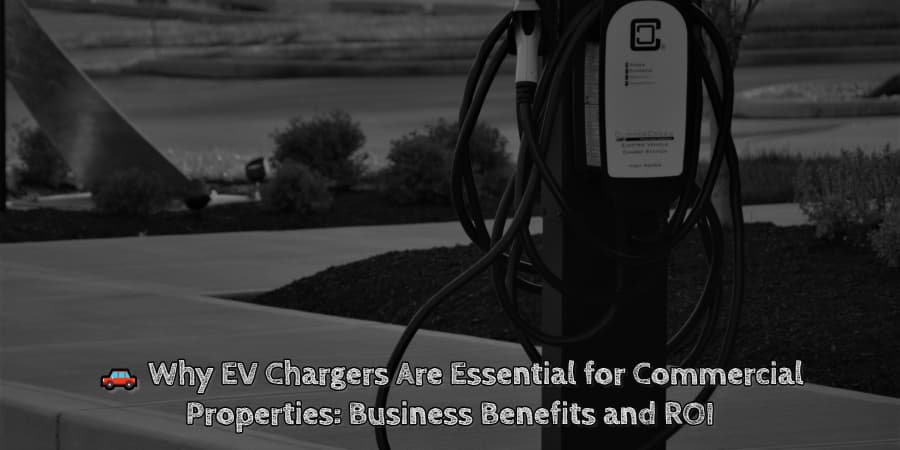
Transform Your Business with Commercial EV Charging Infrastructure
⚡ Installing EV charging stations at commercial properties isn’t just about keeping up with trends—it’s about unlocking new revenue streams, attracting premium customers, and future-proofing your business for the electric revolution.
The electric vehicle market is experiencing unprecedented growth, and the global EV fleet is expected to exceed 50 million by 2025. For commercial property owners, this represents a massive opportunity to capture value from this rapidly expanding market.
The Financial Impact of Commercial EV Charging
Revenue Generation Through Multiple Streams 💰
Commercial EV charging stations create diverse revenue opportunities that can significantly boost your bottom line:
- Direct charging fees: Businesses can charge EV drivers for electricity consumption based on time or energy used
- Increased dwell time: A 2023 Boston University study found that foot traffic at retail establishments increased an average of 4% after installing a nearby Tesla fast-charging station
- Premium pricing: A recent study of 140,000 California businesses found that installing just one EV charging station nearby led to a 1.4% sales boost, translating to $6.7 million
Property Value Enhancement 🏢
EV chargers at rental properties are considered premium amenities, often allowing real estate developers and landlords to charge higher fees. This added feature leads to notable increases in property values for owners and managers of office buildings, apartments, and commercial spaces.
| Property Type | Average Value Increase | Tenant Retention Benefits |
|---|---|---|
| Office Buildings | 5-8% premium | Higher renewal rates |
| Retail Centers | 3-6% increase | Extended customer visits |
| Multifamily | 4-7% boost | Attract premium tenants |
Customer Attraction and Retention Benefits
Meeting Growing EV Driver Demand 🚗
McKinsey estimates there will be 48 million EVs on US roads by 2030. Many of these drivers actively seek businesses where they can charge their vehicles, especially during extended visits.
Key customer benefits include:
- Convenience factor: EV owners choose properties with charging over those without
- Mobile app integration: Dedicated apps help EV drivers locate your charging stations
- Brand loyalty: Customers return to locations where they can reliably charge
Employee Satisfaction and Recruitment 👥
PwC estimates that by 2030, 17% of all charging points will be at workplaces. Providing workplace charging helps attract top talent and encourages employees to return to the office post-COVID.
Government Incentives and Tax Benefits
Federal Tax Credits 📊
The Alternative Fuel Vehicle Refueling Property Credit applies only to eligible census tracts (low-income communities or non-urban areas). For commercial properties, the credit is:
- 6% of installation costs (standard rate)
- 30% of installation costs IF prevailing wage and apprenticeship requirements are met
- $100,000 maximum per charging port
Example calculation with prevailing wage requirements:
- $350,000 EV charger project (7 charging ports)
- Maximum $100,000 tax credit per port
- Potential maximum credit: $700,000 (if all ports qualify)
- Net cost: Significant reduction possible
State and Local Incentives 🏛️
Many states offer additional rebates and grants:
- California’s CALeVIP program
- New York’s Charge Ready NY
- Utility company rebates nationwide
Important limitations:
- Location restrictions: Only available in low-income community census tracts or non-urban census tracts
- Prevailing wage requirements: Must meet Department of Labor standards for 30% credit rate
- Per-port maximum: $100,000 limit applies to each individual charging port
Use the IRS Census Tract Eligibility Tool to verify your location qualifies before installation.
Future-Proofing Your Business
Regulatory Compliance ⚖️
Many states and municipalities now require EV-ready or EV-installed spaces for new developments. Installing charging infrastructure now positions your property ahead of mandates and regulations.
Sustainability Leadership 🌱
Online searches for sustainable goods increased globally by 71% from 2016 to 2021, and 84% of global consumers consider sustainability important when choosing a brand.
For businesses involved in automotive maintenance and repair, such as those covering Honda radio troubleshooting and other vehicle systems, EV charging infrastructure demonstrates forward-thinking automotive expertise.
Types of Commercial EV Charging Solutions
Level 2 Chargers (Most Popular) ⚡
- Power output: 7.2kW to 19.2kW
- Charging speed: 2-10 hours for full charge
- Best for: Workplaces, retail centers, multifamily properties
- Cost: $2,000-$6,000 per unit
DC Fast Chargers (Quick Charging) 🚀
- Power output: 50kW to 350kW+
- Charging speed: 20-60 minutes for 80% charge
- Best for: Highway locations, convenience stores, fleet depots
- Cost: $40,000-$150,000 per unit
| Charger Type | Installation Time | Revenue Potential | User Experience |
|---|---|---|---|
| Level 2 | 1-2 days | Moderate | Convenient |
| DC Fast | 1-2 weeks | High | Premium |
Installation and Infrastructure Considerations
Site Assessment Requirements 🔍
Before investing in EV charging stations, conduct a thorough site assessment including evaluating available electrical capacity and assessing parking layouts.
Key factors to evaluate:
- Electrical capacity: Current panel load and upgrade requirements
- Parking layout: Optimal charger placement for accessibility
- Future scalability: Room for expansion as demand grows
Energy Management ⚡
Integrating EV chargers can increase electricity demand, so managing energy efficiently is crucial through load management software and preventing grid overload.
Recommended Commercial EV Charging Products
ChargePoint HomeFlex Level 2 EV Charger 🏆
This enterprise-grade charging solution offers exceptional reliability and smart features perfect for commercial installations. With a product rating of 4.5 out of 5 stars from 874 reviews, it’s proven in real-world applications.

19/06/2026 11:01 pm
Why it’s ideal for commercial use:
- Scalable network: Access to ChargePoint’s extensive charging network
- Smart management: Monitor usage, set pricing, and manage access
- Robust construction: Weather-resistant design for outdoor installations
- Professional support: 24/7 technical assistance and maintenance
The ChargePoint system integrates seamlessly with existing infrastructure and provides comprehensive reporting for business intelligence.
EVIQO Level 2 EV Charger (48 Amp) ⭐
EV expert Tom Moloughney gave the EVIPOWER a 98-point rating in a review, making it the #1 BEST EV CHARGER of 2024. This commercial-grade solution delivers exceptional performance and reliability.

17/06/2026 11:34 am
Commercial advantages:
- Maximum efficiency: 48-amp output for fastest Level 2 charging
- Extended durability: Heavy-duty construction with 3-year warranty
- Smart app control: Schedule charging, monitor usage, and set rates
- Universal compatibility: Works with all EV models in North America
The only brand with a 4.9-star rating from over 700 reviews and ranked #2 Best Seller, EVIQO represents cutting-edge charging technology perfect for forward-thinking businesses.
Market Trends and Growth Projections
Exponential EV Adoption 📈
Electric vehicles accounted for approximately 10% of new light-duty vehicle sales in the U.S. in 2024, reflecting significant adoption acceleration.
Key statistics:
- EV sales projected to reach 481,000 units in 2025
- 48 million EVs expected on US roads by 2030
- Need for 1.2 million public charging ports by 2030
Charging Infrastructure Gap 🎯
The U.S. has roughly 70,000 publicly available stations with 200,000 charging ports, but this falls short of meeting growing demand. This supply-demand imbalance creates significant opportunities for commercial property owners.
For automotive enthusiasts interested in vehicle maintenance beyond EVs, resources like MotorBeast’s engine oil mixing guide provide valuable insights into traditional automotive care.
Implementation Strategy for Commercial Properties
Phase 1: Assessment and Planning 📋
- Electrical evaluation: Assess current capacity and upgrade requirements
- Site selection: Identify optimal charging locations
- Permit acquisition: Navigate local building codes and regulations
- Financial planning: Calculate ROI and available incentives
Phase 2: Installation and Deployment 🔧
- Professional installation: Use certified electricians and EV specialists
- Network integration: Connect to charging management systems
- Signage and marking: Clear identification of charging areas
- Staff training: Educate employees on system operation
Phase 3: Operations and Expansion 🚀
- Performance monitoring: Track usage patterns and revenue
- Customer feedback: Gather insights for improvements
- Scalable expansion: Add capacity based on demand
- Maintenance planning: Ensure consistent uptime and reliability
Conclusion: The Electric Future is Here
Installing EV charging stations at commercial properties represents more than just keeping pace with technology—it’s a strategic investment in your business’s future. With substantial government incentives reducing costs by up to 30%, proven revenue generation through multiple streams, and growing customer demand for charging infrastructure, the question isn’t whether to install EV chargers, but how quickly you can implement them.
The combination of increased property values, enhanced customer attraction, employee satisfaction benefits, and future regulatory compliance makes commercial EV charging infrastructure one of the most compelling investments available to property owners today.
Related Posts
- Euro 7 Emissions Standards 2026: The Revolutionary New Rules Transforming European Cars
- How to Bleed Brakes on an Older Car Naturally
- Electric Cars With The Longest Range in the USA in 2025 ⚡
- Porsche Taycan Review: The Complete Truth About Models, Problems, and Ownership Costs
- What Are The Symptoms Of a Bad Alternator?