

The Rise of Electric Vehicles 🚗⚡
The electric vehicle revolution is transforming transportation, but the environmental impact of battery production and disposal remains a complex challenge that requires innovative solutions.
Electric car batteries contain valuable materials that can be recycled, but current recovery rates remain low despite growing industry investment in sustainable solutions.
Electric vehicles have exploded in popularity as governments worldwide push for cleaner transportation. The Asia Pacific lithium-ion battery recycling market dominated in 2024, while electric vehicle sales surpassed 2.3 million, up 25% from the previous year according to the International Energy Agency.
Electric cars offer zero tailpipe emissions and significantly lower operating costs than conventional vehicles. This makes them particularly valuable for drivers in urban areas with emission zones like London’s ULEZ, where electric vehicles are exempt from daily charges. With charging infrastructure expanding rapidly, EVs are becoming increasingly practical for daily use.
Understanding Electric Car Battery Technology
Battery Chemistry and Components
Modern electric vehicles primarily use lithium-ion batteries containing several key materials:
- Lithium – Essential for energy storage
- Nickel – Improves energy density
- Cobalt – Enhances battery stability
- Manganese – Provides structural integrity
- Copper – Conducts electricity efficiently
The International Energy Agency (IEA) tells us that an electric vehicle requires six times the mineral inputs of a gasoline-powered vehicle, highlighting the resource intensity of battery production.
Battery Lifespan and Performance
EV batteries typically last 8-15 years or 150,000-300,000 miles. Recent data shows that 97.5% of EVs are still using their original batteries (outside major recalls), and the replacement rate falls to under one percent for EVs made from 2016 onward.
Environmental Impact of Battery Production
Mining and Manufacturing Challenges ⚠️
Battery production creates significant environmental challenges that extend beyond the vehicle itself. About 40 percent of the climate impact from the production of lithium-ion batteries comes from the mining and processing of the minerals needed.
Key environmental concerns include:
- 🔴 Water consumption – Lithium mining requires substantial water resources
- 🔴 Carbon emissions – Manufacturing processes are energy-intensive
- 🔴 Habitat disruption – Mining operations impact local ecosystems
- 🔴 Chemical pollution – Processing can release harmful substances
Satellite analysis in Cuba has shown a devoid of life in over 570 hectares of land and contamination of over 10 kilometres of coastline where nickel and cobalt mines are present.
Lifecycle Environmental Impact ✅
Despite production challenges, EVs still outperform gasoline vehicles in total environmental impact. Study after study has found a clear benefit to EVs when considering the complete lifecycle from manufacturing to disposal.
🟢 Building a battery is an environmental cost that’s paid once. 🔴 Burning gasoline is a cost that’s paid again, and again, and again.
Battery Recycling: Current State and Challenges
Low Recovery Rates
Current battery recycling rates remain disappointingly low. Currently, only 1-3% of lithium is recovered globally from recycled batteries, mainly due to the high costs involved in the extraction process.
While 90 percent of average gasoline-powered vehicle batteries are recycled, at the moment, a much lower percentage of lithium-ion batteries are successfully recycled.
Recycling Methods 🔄
The industry employs three main recycling approaches:
Pyrometallurgy – High-temperature smelting to recover metals
- 🟢 Effective for cobalt, nickel, and copper recovery
- 🔴 Energy-intensive process with high emissions
- 🔴 Limited lithium recovery capability
Hydrometallurgy – Chemical dissolution processes
- 🟢 More environmentally friendly than pyrometallurgy
- 🟢 Can recover up to 99% of lithium with relatively lower energy usage
- ⚠️ Uses chemical solvents for material extraction
Direct Recycling – Preserves battery structure
- 🟢 Minimal processing required
- 🟢 Retains active material integrity
- 🔴 Currently limited scalability
Industry Growth and Investment 📈
The recycling industry is experiencing explosive growth. The Global Lithium-Ion Battery Recycling Market is set to grow from $7.3B in 2024 to $23.9B by 2030, at a CAGR of 21.9%.
🟢 Global recycling capacity reached over 300 GWh/year in 2023, of which more than 80% was located in China, demonstrating the massive scale of investment in recycling infrastructure.
Innovative Solutions and Technologies
Second-Life Applications
Battery reuse extends environmental benefits beyond the vehicle lifecycle. Once an EV battery is no longer suitable for use in vehicles, it can still be repurposed for other applications, such as:
- Home energy storage systems
- Grid-scale electricity storage
- Backup power solutions
- Renewable energy integration
Advanced Recycling Technologies
New techniques must reduce costs and enhance recovery rates for recycling to be financially viable. Emerging innovations include:
- Enhanced hydrometallurgical processes achieving 99%+ recovery rates
- Automated disassembly systems for safer processing
- Solvent-free extraction methods reducing chemical waste
- AI-powered sorting systems improving efficiency
Regulatory Support
Government policies are accelerating recycling development. European Union regulations now require that EV batteries contain a minimum of 6% recycled lithium and nickel by 2030, creating strong incentives for recycling investment.
Economic Considerations 💰
Cost Factors
Battery recycling faces significant economic challenges:
- 🔴 Transportation costs for hazardous materials
- 🔴 Complex disassembly requirements
- 🔴 Fluctuating commodity prices
- 🔴 Specialized facility investments
🟢 Many battery materials are valuable enough to repay the intensive work of recycling them—although we should still expect lots of demand for newly-mined nickel, cobalt, lithium and copper.
Market Drivers
Several factors are improving recycling economics:
- 🟢 Rising material costs making recycled content more valuable
- 🟢 Regulatory requirements mandating recycling targets
- 🟢 Scale economies as recycling volumes increase
- 🟢 Technological improvements reducing processing costs
Future Outlook and Solutions
Technology Improvements
Battery technology continues evolving toward more sustainable designs:
- Reduced cobalt dependence through new chemistries
- Enhanced recycling compatibility in battery design
- Improved durability extending battery lifespans
- Standardized components simplifying recycling
Circular Economy Development
Mercedes-Benz inaugurated its first in-house battery recycling facility in Kuppenheim, Germany, employing an integrated mechanical-hydrometallurgical process. This plant achieves a recovery rate exceeding 96% for critical materials.
The industry is moving toward closed-loop systems where recycled materials directly supply new battery production, reducing dependence on mining.
Consumer Considerations 👥
For EV buyers concerned about environmental impact:
- 🟢 Choose smaller batteries when possible to minimize resource use
- 🟢 Support manufacturers with strong recycling programs
- 🟢 Consider certified recycling when batteries reach end-of-life
- 🟢 Explore second-life applications before disposal
Understanding the total cost of EV ownership including potential savings from emission zone exemptions can help justify the environmental investment.
Recommended Products
Emporia Smart Level 2 EV Charger
Why it’s a great buy: Good Housekeeping ranked Emporia’s EV Charger the best overall charger of 2024. With over 1,800 Amazon reviews averaging 4.7 stars, this $399 charger offers exceptional value.

07/11/2025 7:29 pm
Key features:
- 48-amp hardwired / 40-amp plug-in charging
- Smart WiFi connectivity with mobile app
- Energy Star certified efficiency
- Compatible with all EV types
The Emporia charger integrates seamlessly with home energy systems and can automatically charge from excess solar power, making it perfect for environmentally conscious EV owners.
ANCEL BA101 Car Battery Tester

07/11/2025 2:24 pm
Why it’s essential: The Ancel BA101 is rated, officially, to be more than 99% accurate and helps prevent unexpected battery failures through regular testing.
Professional features:
- Tests 12V batteries from 100-2000 CCA
- Comprehensive alternator and starter testing
- Digital display with detailed diagnostics
- Compact portable design
Perfect for EV owners who want to monitor their vehicle’s electrical system health and ensure optimal battery performance. Regular testing can extend battery life and prevent costly replacements.
Understanding EV Charging Levels
Level 1 vs Level 2 vs Level 3 Charging 🔌
| Charging Level | Voltage | Speed | Range Per Hour | Best For | Installation | Cost |
|---|---|---|---|---|---|---|
| Level 1 | 120V | 🔴 Slowest | 2-5 miles | 🟢 Emergency charging, PHEVs | 🟢 Standard outlet | 🟢 Included with EV |
| Level 2 | 240V | 🟢 Fast | 25-40 miles | 🟢 Home & workplace | ⚠️ 240V outlet/hardwiring | ⚠️ $400-$1,500 |
| Level 3 | 480V DC | 🟢 Fastest | 200+ miles | 🟢 Public stations, commercial | 🔴 Commercial infrastructure | 🔴 $40,000-$175,000+ |
Why Level 3 Chargers Aren’t Available for Home Use 🏠❌
Level 3 chargers require massive electrical infrastructure that makes them impractical for residential use:
- 🔴 480V power supply – Most homes only have 240V service
- 🔴 Professional installation requiring transformers and specialized permits
- 🔴 Extreme costs ranging from $40,000 to $175,000+ per unit
- 🔴 Commercial electrical requirements that exceed typical home capacity
Amazon search results confirm that while Level 3 chargers exist on the platform, they’re exclusively commercial-grade units like the Primecom.Tech 60kW charger designed for business installations.
EV Charging Adapter Solutions
For Tesla owners wanting to access non-Tesla charging networks, charging adapters provide flexibility:
CCS1 to Tesla Adapters

07/11/2025 7:29 pm
- Enable Tesla vehicles to use CCS1 DC fast chargers
- Support up to 250kW charging speeds
- Price range: $150-$400 on Amazon
- Compatible with major charging networks
J1772 to Tesla Adapters
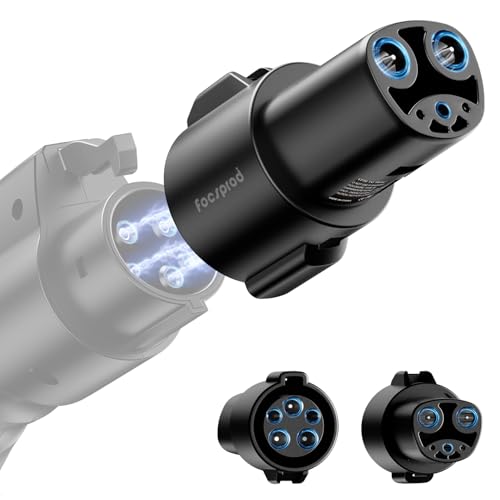
07/11/2025 7:29 pm
- Allow Tesla access to Level 2 AC charging stations
- Support up to 80A charging current
- More affordable option for slower charging needs
- Universal compatibility with J1772 networks
Battery Health and Maintenance
Maximizing EV Battery Lifespan 🔋⚡
Proper charging habits significantly impact battery longevity:
- 🟢 Avoid frequent 100% charges – Lithium batteries prefer 20-80% range
- 🟢 Use Level 2 charging for daily needs to reduce heat stress
- 🟢 Minimize DC fast charging to special occasions and long trips
- 🟢 Store at moderate temperatures when possible
Battery Monitoring Technology
Modern EVs include sophisticated battery management systems that:
- Monitor individual cell voltage and temperature
- Balance charging across cells to prevent degradation
- Protect against overcharging and thermal runaway
- Provide real-time health data to drivers
Signs of Battery Degradation ⚠️
Watch for these indicators that may signal battery issues:
- 🔴 Reduced driving range on full charge
- 🔴 Longer charging times than normal
- 🔴 Inconsistent power delivery during acceleration
- 🔴 Warning messages from vehicle systems
The Global EV Charging Infrastructure
Current Charging Network Status 🌐
Global EV charging infrastructure is expanding rapidly:
- 🟢 Over 2.7 million public chargers worldwide in 2024
- 🟢 China leads with 80% of global charging capacity
- 🟢 Europe and North America rapidly expanding networks
- 🟢 Tesla Supercharger network opening to other brands
Future Charging Technologies 🚀
Next-generation charging solutions promise even faster speeds:
- ⚡ 350kW+ ultra-fast charging reducing charge times to 10-15 minutes
- 📡 Wireless charging technology for automatic charging
- 🔄 Vehicle-to-grid (V2G) capabilities allowing EVs to supply power back to the grid
- ☀️ Solar-integrated charging stations for carbon-neutral energy
The Verdict: Is Going All Electric Worth It? 🤔
Based on the comprehensive data I’ve reviewed, going all electric is a net positive move despite current challenges. Study after study has found a clear benefit to EVs when considering lifecycle analysis, with research showing that an EV is typically responsible for lower levels of greenhouse gases than an average new gasoline car, even accounting for battery production and electricity emissions.
Building a battery is an environmental cost that’s paid once, while burning gasoline is a cost that’s paid again, and again, and again. While battery production does create significant environmental impacts through mining and manufacturing processes that are 3 times more energy intensive than conventional vehicle batteries, the rapidly expanding recycling industry (growing from $7.3B in 2024 to $23.9B by 2030) and improving recovery rates (with some facilities achieving 96%+ material recovery) are addressing these concerns.
For many drivers, especially those in emission-controlled zones, the benefits of switching to electric extend beyond environmental considerations to include daily cost savings and regulatory compliance.
References:
- NPR: “Their batteries hurt the environment, but EVs still beat gas cars”
- EPA: “Electric Vehicle Myths”
- Institute for Energy Research: “Environmental Impacts of Lithium-Ion Batteries”
- Grand View Research: “Lithium-Ion Battery Recycling Market Report”
Related Posts
- Can I Install an EV Charger at Home Myself?
- Euro 7 Emissions Standards 2026: The Revolutionary New Rules Transforming European Cars
- Should You Buy An Electric Vehicle? Why the EV Dream is Failing in the UK While America Offers Hope
- How to Bleed Brakes on an Older Car Naturally
- Electric Cars With The Longest Range in the USA in 2025 ⚡